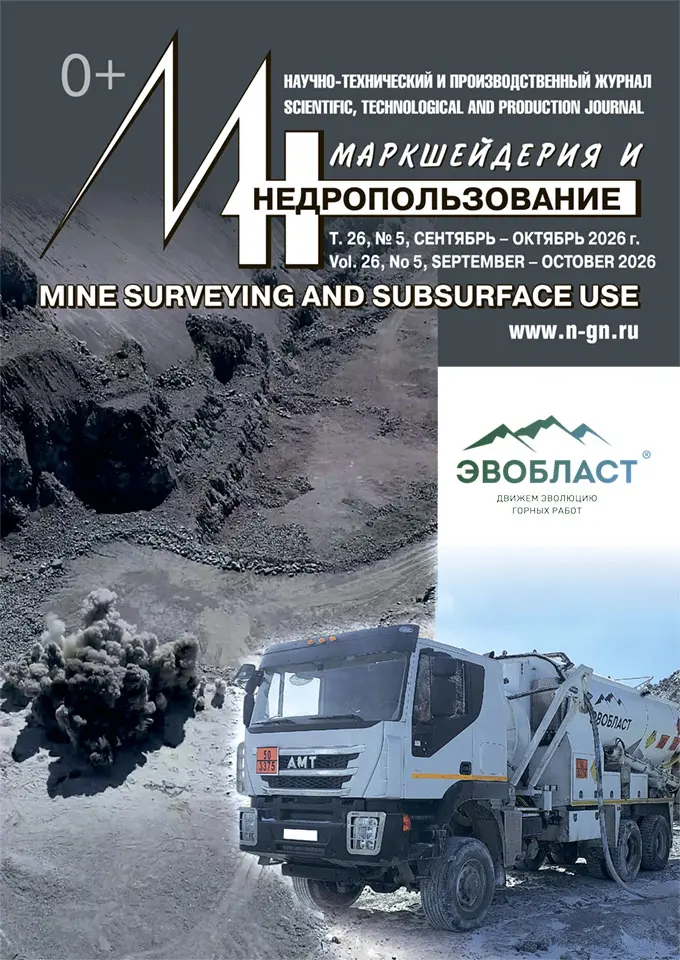
Read in this issue:
Increasing of a blasted block width in the open pit final-wall zone by using relief pauses with keeping safety vibration
I.O. Kovalchuk, А.А. Dobrynin, R.A. RakhmanovThis paper presents the results of measurements of blast-induced ground vibration from a production blast in the finalwall zone of an open pit, including an analysis of the effect of the blasted block width on the amplitude of peak particle velocity in the rock mass.
The current state and prospects of organizing the use of artificial intelligencein mining safety issues
V.A. Atrushkevich, S.M. PopovExamines the current state and prospects for organizing the use of AI in ensuring the safety of mining operations. Promising directions for the development of AI in the mining industry have been substantiated. Recommendations have been developed to AI application in the industrial safety system.
Relationships of iron and sulfur content with gas content and heterogeneity of microstructure of coals
I.N. Gorshenkov, B.N. Pashichev, E.V. UlyanovaThe study relates iron, sulfur and pyrite contents and the iron-to-sulfur balance to total gas content and microstructure in methane-bearing coal seams. Positive gas-content associations are found; a higher balance lowers entropy and raises complexity, aiding methane control, not proving mechanism.
Method of forming a borehole charge with cartridged emulsion explosive in flooded boreholes at construction material quarries in Primorsky krai
A.R. Tukhbatulin, Yu.A. Vasyanovich, P.S. TaranThe issue of loading water-filled boreholes with packaged emulsion explosives is examined for situations where the use of mobile mixing-and-loading units is either impossible or economically unfeasible. The traditional manual loading method often leads to problems.
Features of environmental impact forecasting in designing an environmentally sustainable mining system
N.V. Gonchar, S.V. Kornilkov, I.A. Chetverkin, V.A. PikalovThe paper presents the structure and sequence of geological-structural and hydrogeological modeling to forecast hydrogeological and geomechanical consequences when using tailings for the liquidation of mine workings. An approach to creating coupled models is described.
Development of an algorithm for modeling mineral deposits based on a spatial Мarkov chain with a fixed path
А. А. BasarginThe results of developing an algorithm for modeling mineral deposits—based on a spatial Markov chain with a fixed path and incorporating interclass dependencies—are presented. The algorithm for modeling mineral deposits, designed to determine deposit characteristics, is described in detail.
Composite typing of geometric structures of a three-dimensional geochemical field in a porphyry copper system
I.O. PanichkinThis study proposes a method for composite typing of geometric structures within the three-dimensional geochemical field of a porphyry copper system. The method is intended to divide an ore field into high-potential, transitional and low-potential mininggeological types.
Drilling and blasting of large-section mining workings in permafrost conditions by the solid failing method
V.F. Gutnik, A.N. AnushenkovThis article presents and describes in detail an innovative cutting scheme and drilling and blasting protocols that enable efficient development of large-diameter mine workings using continuous face mining in permafrost conditions. It also presents a methodology for its development.
Technology for increasing the oxidation potential of recycled solutions for uranium in-sit leaching
Ye.S. Oryngozhin, R.A. Yusubaliev, Ye.Ye. Oryngozha, I.M. MalakhovaPresents theoretical studies of the physicochemical mechanisms of leaching processes related to the oxidation-reduction conditions of the environment, the ability of elements to form compounds with other elements, form ions of varying valence, yield soluble or gaseous compounds.
Determination of advance sampling grid parameters for coal quality control in a complex-structure seam
E.A. TagaevA methodological approach is proposed for determining the parameters of a proactive coal-sampling network for complex-structured seams, based on the modeling of quality indicators. This approach has been tested on a coal seam at the Elginskoye deposit.
Characteristics of methane emission from a coal seam being mined in zones of geological discontinuities
E.V. Fedorov, S.B. Kulibaba, N.A. MiletenkoActual operational data from a longwall mining system were investigated regarding the intersection of fault-type geological discontinuities in the coal seam and the performance of preliminary in-seam degasification boreholes within these zones.
Integration of Fourier analysis and neural network models for assessing hydrometeorological hazards in the North Caucasus federal district
A.I. LazovskyAn integrated analysis of North Caucasus ecosystem resilience to technogenic stress reveals reduced ecological stability across much of the region, especially mountainous and foothill zones. Mining, agriculture, and urbanization are degradation drivers, necessitating monitoring and land management.
Radon flux density at the Anavgay geothermal, Kamchatka Territory
V.A. KudryashovThe study assesses radon flux density at the Anavar geothermal deposit and its links to tectonic disturbances and man-made wells. Radon flux is uneven, with elevated values near wells rather than tectonic zones, likely because surface deposits screen or disperse deep radon.
Comparative analysis of the stability of rock mass volume calculation methods under varying point-cloud density
M.G. Vystrchil, M.V. Romanov, L.A. Ramirez-MelendezPresents comparative analysis of the stability of rock mass volume estimation methods under varying point-cloud density in open-pit mining conditions. Results can be applied for selecting appropriate spatial-modelling algorithms and processing parameters mine surveying in open-pit mining operations
Laser scanning technologies in the complex of mine surveying support for open-pit mining at a gold deposit
К.Yu. МoskalenkoA methodology for surveying the actual position of mine workings using various laser scanning systems is described. In line with the operational cycle, the methods for mine surveying support of drilling and blasting operations—including high-precision GNSS positioning of drill rigs—are outlined.
Geological and geodynamic conditions for the formation of hydrocarbon deposits in the Southern Pre-Urals
M.V. Andreev, V.P. Petrishchev, G.A. PonomarevaGeological and geodynamic controls on hydrocarbon accumulation in the Southern Pre-Urals are examined. Basement fault-block tectonics is shown to govern sedimentary cover development, reservoir quality, migration pathways, and trap formation. A fault-control model improves local target prediction.
Integrated methodology for studying fault-block tectonics and its influence on petroleum potential
M.V. Andreev, V.P. Petrishchev, G.A. PonomarevaAn integrated approach to fault-block tectonics and petroleum potential is presented for the Southern Pre-Urals. Geophysical, geological, well and production data help map buried faults, refine basement structure and verify fractured zones, improving fractured reservoir prediction and fault models.
Editor’s Note
Doctor of Technical Sciences, Professor, Editor-in-Chief of the journal "Mine Surveying and Subsurface Use"
Dear colleagues, readers and friends!
As the editor-in-chief of the journal "Mine Surveying and Subsoil Use", I am pleased to welcome you to our website. We consistently strive to become reliable scientific information and practical solutions for specialists in the field of mining, geology and mine surveying. Today, we are on the threshold of new opportunities. The world is changing, and along with it, the nature of scientific research and the opinion of science. We are actively developing our journal, focusing on modern trends and clothing of professionals. Among the priority areas of activity in recent years is the active implementation of digital technologies. We are creating an electronic version of the journal, presenting unique content that will be of interest to both young specialists and experienced scientists. In addition, we plan to establish closer cooperation with international standards and educational institutions. This will allow us to consolidate our experience and expand the horizons of our authors and readers. We are confident that the integration of knowledge from different cultures and approaches will lead to new breakthroughs in science and practice. An equally important area is improving the quality of peer review and publication. We will actively involve experts to ensure strict selection of materials, which will strengthen the reputation of our journal in the international arena. Our journal is not just a platform for publishing articles, but also a community uniting professionals who are eager to share knowledge and experience. We invite you to participate in our development, in your achievements, in your work and ideas. Together we will implement "Mine Surveying and Subsoil Use" to the leading publications in the field of mining science and technology!
About Journal
"Mine surveying and Subsurface Use" - Scientific, Technological and Production Journal
Since its foundation in 2001, the journal "Mine Surveying and Subsoil Use" has become an integral part of the scientific and professional community in the field of mining, geology and mine surveying, a scientific compass for industry specialists. Each issue offers readers unique research, reviews and practical articles that highlight modern problems and innovations facing the industry. On the pages of our publication you can find materials that are suitable for both experienced specialists and novice scientists, allowing them to deepen their knowledge and find new approaches to solving current problems. The journal actively discusses such important topics as process automation, production management technologies and ecology, as well as issues of sustainable development and resource conservation. The editorial board, consisting of recognized experts, ensures high quality of publications and their review. We strive for openness and accessibility of knowledge, so all articles are available for free reading, which allows all interested parties to receive up-to-date information without barriers. In addition to scientific publications, the magazine provides information on key events in the industry, such as exhibitions, conferences and forums, where you can exchange experiences and find new partners. We invite you to subscribe to the magazine and stay up to date with the latest achievements in mining science and technology. Read more